AI headshots are getting very good at average. Here's why that's the problem

Updated: May 30
The question everyone's asking in 2026: AI headshots vs professional photographer - which one actually works?
Scroll LinkedIn long enough and you’ll start noticing it.
Perfect lighting.
Clean backgrounds.
Polished faces.
And yet something feels… off.
AI headshot tools are everywhere now. They’re very good at making you look like a professional.
They’re just not very good at making you look like you in a way that supports your personal branding .
I ran the test on myself.
Testing AI Headshots vs Professional Photography: my Process
"I run OLBRAND, a visual brand strategy studio in Amstelveen. My work is translating positioning into images that communicate something specific about who you are and where you’re going.
Idea was to understand:
Can AI replace what I do?
I uploaded the same photo i realy like into four AI headshot tools and asked for professional brand photography.
Same input.
Same goal.
Completely different results.
Context matters here.
I’m Ukrainian, based in the Netherlands for twelve years. My clients are consultants, founders, and coaches navigating transitions. My image needs to communicate strategic and approachable across cultures.
ob
AI had no way to know any of that.
Four AI Headshot tools tested: ChatGPT, Canva, Headshotmaster, ProfileBakery
ChatGPT Imagecx f Creation
Cinematic, emotional, dramatic. Honestly, I like these results.
It had all the props: natural light, environmental context, storytelling composition, but the person in the photo had narrow shoulders and an elongated neck I don't have.
Verdict: Technically strong. Strategically irrelevant.


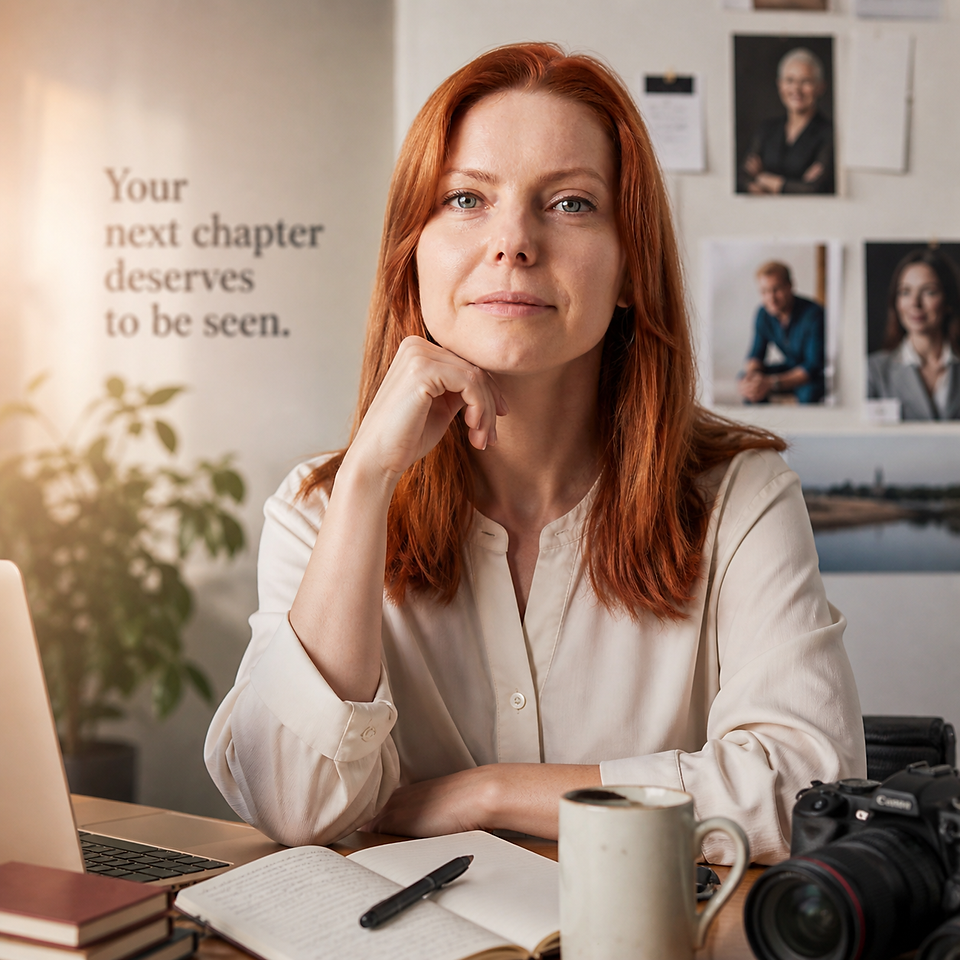

AI headshot result from ChatGPT vs professional brand photography
Canva AI Headshot Generator
Statistically average. Fake smile, plastic skin, generic corporate vibe. The kind of photo that could belong to anyone in any industry. Not my favorite, and definitely not me.
Verdict: Statistically average. Says nothing.

This one looked like it belonged to a security officer from the Hollywood film. Or worse. (I'm saying this without judgment). The vibe was off, and nothing about it said "personal branding photographer in Amsterdam."
Verdict: Communicates something. Not what I need.

ProfileBakery
Clean, professional, looked somewhat like me. But still felt slightly off. The expression was neutral-pleasant. The image communicated "professional person" but not "this specific professional at this specific moment."
Verdict: The best of the four. Would pass on LinkedIn, but still a placeholder.
What AI Headshots do well (and when they work)
AI headshots aren’t bad.
If all your photo needs to do is look professional, they work.
Team directories
Internal profiles
Low-budget placeholders
They solve a real problem. Especially at scale.
That’s a legitimate use case.
Where AI breaks down vs professional photography
The moment your image needs to do more than fill a box.
All four tools did something right.
None of them did the thing that actually matters.
They made me look like a professional.
Not like this professional at this moment, with this positioning.
Why this happens
AI is trained on thousands of “good” photos.
So it produces the average:
Safe
Polished
Familiar
Forgettable
If your photo looks interchangeable, you become interchangeable.
That’s fine if your goal is to look acceptable.
It fails when your image needs to build trust, signal authority, or support a transition.
What AI Headshot generators can't capture about personal branding?
1. It can’t understand your context
A consultant going independent doesn’t need a “professional” photo.
They need a photo that says: “I’ve spent fifteen years inside your problems. I know how to solve them.”
That's the kind of positioning work we do in every brand strategy session before the shoot.
2. It can’t respond to your transition
Moving upmarket.
Going solo.
Entering a new market.
Repositioning.
Each requires a different visual signal.
AI can’t ask those questions. It guesses based on probability.
3. It can’t know what you haven’t said
I gave AI a detailed prompt.
It still didn’t know:
I’m moving from recruiter to strategist
Who my clients actually are
What balance I need to communicate
The cultural context my image has to bridge
So it defaulted to pattern recognition.
And pattern recognition is not positioning.
What a good photographer actually does?
A photographer is translating your ideas and goals to visual result.
You come in with a gap:
Between who you were and who you are now
Between how you’re seen and how you want to be seen
The job is to close that gap.
That requires:
Understanding your context
Defining what credibility looks like in your world
Making deliberate visual choices that support it
The photoshoot is execution.
This is why OLBRAND's visual strategy process starts with clarity before the camera comes out.


If your image is wrong, it doesn’t just look off.
It makes people question your credibility.
You go independent → your photo replaces your firm’s credibility
You increase visibility → your image becomes part of the story
You move upmarket → your visual signal needs to match your pricing
If your image isn’t building trust, it’s quietly working against you.
My verdict:
So what's the verdict on AI headshots vs professional photography?
Use AI if:
You just need to look professional
Your positioning is standard
Your image isn’t doing heavy lifting
Work with a photographer if:
You need to build trust quickly
You’re in transition
You’re differentiating
Your image actually matters
If this describes you, here's how we work and what past clients have achieved.
The real question isn’t “Use AI or not?”.The real question is:

Is your image a placeholder - or a positioning tool?
What this means
AI will keep getting better. The lighting will improve, the images will feel more realistic, and the range of variations will keep expanding. That’s not really the issue.
It will still optimize for patterns, and patterns always lead to averages.
That’s the ceiling.
If your work is easy to replace, that’s fine.
But if it isn’t, your image can’t look like everyone else’s.
Ready to translate your vision into images that actually work?
At OLBRAND, we start with clarity: who you are now, where you're going, and what your image actually needs to communicate in that context.
If your current photo still represents who you used to be - not who you are now - that’s the gap.
If your image isn’t building trust or authority yet, and if you’re in Amsterdam or the Randstad and stepping into something bigger, let’s fix that gap.
If you found this helpful, you might also like:
What People Really Notice First in Your Personal Brand - The psychology of first impressions and why your photo matters more than you think
Why Your Photos Might Look Like Passport Pictures - Common mistakes photographers make (and how to avoid them)
How to Show Up with Confidence: Personal Branding Photographer in Amsterdam - A behind-the-scenes look at our visual strategy process


Comments